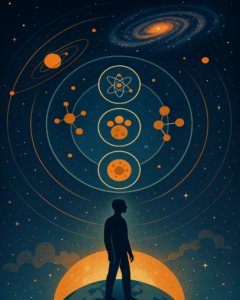


The concept that a whole is made of uncountable parts—and that humans themselves are made of uncountable parts and are also part of the world—can be broken down in many ways that affect and enhance our attitude and attune us to the surrounding reality. Each piece of the Lego is significant yet replaceable; we are part of a whole, and the whole has great power and influence on us.
Over and over, we discover that clear logic, supported by science, leads to the same ancient spiritual wisdoms that have reached us across the ages: the wisdom of acceptance, the wisdom of humility, the wisdom of empathy and tolerance. What we see under the microscope, and what we sense in the depths of the heart, point in the same direction.
I. No Credit, No Shame
Humans are made so that they match the surrounding environment. Creatures are shaped—by the nature of things—to fit the soil that formed them, or vice versa: the soil shapes what grows from it, and the outcome inevitably reflects its source.
We arrive in this world in every shape, form and color. A dark skin matches one kind of sun and climate, a light skin matches another. Different bodies, features and temperaments grow out of different histories, cultures and landscapes.
There is no credit for the black to be black and no shame for the white to be white. No credit, no shame for any body, any color, any inherited trait. Nobody earned it. It was given, with no possibility of choice or struggle.
No credit for the beautiful and no shame for the not-so-beautiful.
No credit for the tall and no shame for the short.
No credit for the born smart, no shame for the born disabled.
Knowing this as a fact might make us humble and can open the mind, reduce judgment, create space for empathy and kindness, extend our tolerance, increase our ability to accept the other, and, most importantly, help us see what truly deserves credit.
II. Life and Death Cycle
All around us, it is obvious that life moves in continuous cycles of birth and death, of arising and fading, in all kinds of living creatures and life forms.
This constant coming and going is not a cruel mistake in the system; it is part of how the universe rejuvenates, evolves and grows. The Lego of existence never stays frozen. Its parts keep receiving “updates”—they are renewed, recycled and rearranged so that life can stay active, healthy and young at all levels.
Knowing this as a fact can deepen our understanding of existence. It can help us:
-
Appreciate the moments of living more fully,
-
Accept the inevitable ending of each form with a little more peace,
-
See death not only as loss, but also as transformation and continuity.
Such a perspective can lead to better self-awareness and a certain kind of inner enlightenment. When we adopt this knowledge, we may discover more space for joy in our lives, even in the presence of impermanence. It can allow us to become more mature and responsible:
-
Mature in how we handle change and loss,
-
Responsible in how we use the limited time and energy we are given as one temporary configuration of the Lego.
III. Interdependence and Responsibility
If we are pieces in a living Lego, it means two things at the same time: we are shaped by the whole, and we help shape the whole.
No thought, word or action truly happens in isolation. Each one travels through invisible threads:
-
Influencing the people close to us,
-
Contributing to the atmosphere in our families, workplaces and societies,
-
And, in small but real ways, affecting the wider world.
Interdependence means that what we do with our small piece of existence matters—not because we control everything, but because we are woven into everything.
This brings us to responsibility. Not the heavy, guilt-soaked responsibility that blames us for the entire world, but a quieter and truer one: response-ability—the ability to respond wisely to what is in our hands.
We are not responsible for:
-
The body, color or basic conditions we were born into,
-
The original shape of our Lego piece,
-
Or the entire structure of the world.
But we are responsible for:
-
How we use what we were given,
-
How we treat those who are directly touched by our actions,
-
And how we contribute—even in small ways—to the health or damage of the larger wholes we belong to.
In a deeply interconnected reality:
-
A small act of honesty can strengthen trust in a whole group,
-
A small act of courage can inspire others to move,
-
A small act of cruelty can echo far beyond the moment in which it was done.
Interdependence calls us to own our influence without exaggerating it and accept our limits without using them as an excuse. It invites a balanced attitude:
-
Humility, because we see how much of us was given, not earned.
-
Gratitude, because we understand how many seen and unseen forces support our existence.
-
Responsibility, because we recognize that our choices are tiny but real votes in the ongoing creation of the whole.
In this light, “All is one” is not just a comforting sentence. It becomes a quiet daily reminder: You are a piece of the Lego, but not just a piece. You are shaped by the whole you belong to, and at the same time, you help decide what that whole becomes next.
IV. The Bird-Eye Effect
When we say “all is one” and “wholes made of countless pieces,” we are also invited to change the place we look from. Instead of being trapped inside a single Lego piece, we can sometimes rise above and see more of the structure. This is the bird-eye effect.
Seeing things from this higher angle allows us to:
-
Measure more correctly the weight and importance of events and behaviors,
-
Notice when we are exaggerating a small incident or, on the contrary, ignoring something truly serious,
-
Realize the wider implications a certain action has—not only on us, but on others and on the systems we belong to.
From close up, a conflict, a failure or a criticism can feel like everything. From the bird’s-eye view, it becomes:
-
One moment in a much longer story,
-
One move among many moves in the game,
-
One rearrangement of Lego bricks in a structure that keeps changing.
This perspective does not ask us to deny our feelings or pretend that pain is nothing. It simply helps us to put things in their right place:
-
To see which problems are truly life-changing and which are temporary,
-
To distinguish between what deserves deep attention and what can be allowed to pass,
-
To recognize patterns, not only isolated events.
The bird-eye effect can:
-
Calm our reactions,
-
Reduce unnecessary drama,
-
Give us the inner space to choose wiser responses.
When we remember the whole, we are less likely to be swallowed by one single piece. We can respect our experiences without letting them define the entire universe. In this way, the bird-eye effect becomes a practical expression of “All is one”: it teaches us to see our life not as a collection of disconnected accidents, but as part of a larger, meaningful pattern where every piece has a place—and no single piece is the whole story.
V. Freedom and Limits
At first glance, “All is one” might sound like the end of individuality and freedom. If everything is connected, if we are just one piece in the Lego, where is my freedom? The answer lies in understanding the role of limits.
Every Lego piece has a specific shape:
-
It cannot be everywhere at once,
-
It cannot connect to everything,
-
It has a defined place where it fits best.
Our human life is similar. We are born into:
-
A certain body and nervous system,
-
A particular family, culture and time in history,
-
A finite lifespan with limited energy and attention.
These are our limits. At first they may feel like a prison, but if we look carefully, we see that they are also the frame that makes any freedom possible.
Without limits:
-
A Lego piece would not hold any structure together,
-
A note in music would not create harmony or rhythm,
-
A human life would not have direction.
Freedom does not mean being able to do everything. Real freedom is the ability to choose wisely within the space we actually have.
In practice, this means:
-
Accepting that we cannot be good at everything, and focusing on the gifts we do have,
-
Recognizing that we cannot save everyone, but we can genuinely help the ones life places in front of us,
-
Understanding that we cannot control outcomes, but we can choose our intentions and our efforts.
When we see ourselves as one piece in a larger whole:
-
We stop wasting energy fighting the limits that cannot be changed,
-
And we redirect that energy into creative action where we truly can move something.
This combination creates a deep, quiet freedom:
-
Free from the illusion that we must be everything,
-
Free from the despair that we are nothing,
-
Free to be exactly what we are—and to live that fully.
“All is one” then becomes a paradoxical doorway: the more honestly we accept our limits as one piece of the Lego, the more authentically free we become inside that shape.
VI. Compassion and Love
If all is one, and if every being is a piece in the same living Lego, then compassion and love are not optional decorations. They are the natural language of this reality.
Compassion begins when we see:
-
That no one designed their own starting point,
-
That everyone carries invisible histories, wounds and fears,
-
That the other is made of the same basic materials as we are.
From this perspective:
-
The person we envy is also carrying burdens we do not see,
-
The person we judge is also shaped by conditions they did not choose,
-
The person we fear or dislike is also a necessary piece in the larger picture.
Compassion is not weakness. It is the courage to look at another human being and silently remember: You too are a piece of this one life. You too are being shaped by forces seen and unseen. You too are trying, in your own way, to live inside your conditions.
Love goes one step further. While compassion softens judgment, love chooses connection:
-
Sometimes as tender care,
-
Sometimes as honest boundaries,
-
Sometimes simply as a quiet wish for the other to be well, even from a distance.
In the Lego of existence, love is the force that:
-
Allows pieces to connect in meaningful ways,
-
Heals cracks between them,
-
Motivates us to use our freedom not only for ourselves, but for the wellbeing of the whole.
This includes self-compassion. If we truly believe that all is one, then:
-
Attacking ourselves relentlessly is just another form of violence within the whole,
-
Forgiving ourselves and learning from our mistakes is an act of healing that benefits more than just me.
Compassion and love do not erase differences, pain or injustice. But they change the quality of our participation:
-
From cold indifference to warm presence,
-
From blind reaction to conscious response,
-
From me against you to you and I inside the same vast mystery.
VII. Outer Consideration – The Prison of Image
There is another layer to our life inside the Lego of existence: how much we care about how we are seen by the other pieces.
By outer consideration we mean this: we constantly consider the opinions of others, and we care deeply—sometimes obsessively—about our image in their eyes.
This is not a physical limit like our body or our lifespan. It is an artificial limit: our minds created it under the influence of the environment. We were not born with it.
Slowly, through families, schools, cultures and social media, we learn to:
-
Check ourselves through imagined eyes of others,
-
Measure our worth by external approval,
-
Fear rejection more than we fear losing ourselves.
This can become a subtle but powerful prison:
-
It squeezes us into a mold shaped by others’ expectations,
-
It wastes our energy on constant self-monitoring,
-
It adds daily, continuous pressure on our actions and choices.
Instead of asking, “What is true, good, or meaningful?” we start asking, “How will this look? What will they say?”
The Lego concept can help to free us from this prison. If every piece is:
-
Given its basic shape by forces it did not choose,
-
Necessary but not central to the entire structure,
-
One of countless unique forms in the whole,
then our value does not depend on perfect performance or universal approval. We are already part of the structure by existing.
Seeing ourselves as one Lego piece among many can:
-
Soften the fear of being wrong in the eyes of others,
-
Remind us that nobody has the full picture to judge us completely,
-
Encourage us to act from inner alignment rather than from the need to polish our image.
Outer consideration will probably never disappear completely—we are social beings. But it can move from being a prison guard to being just a signal:
-
“What others think” becomes one piece of information,
-
Not the master that rules our every move.
When we remember “all is one—wholes made of countless pieces”, we are invited to live more from inner truth and less from external image:
-
Still respectful of others,
-
Still open to feedback,
-
But no longer sacrificing our authenticity at the altar of approval.
In this way, the Lego vision does not only open us to humility, responsibility and compassion—it also offers us a gentle path out of the invisible cages our own minds have built.